What is India’s status regarding rabies occurrence and management?
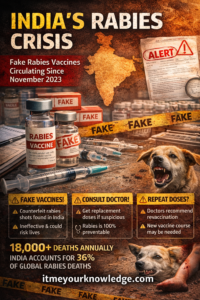
Has the problem been rectified? Should patients repeat the doses?
The Centers for Disease Control and Prevention in the U.S. and the Australian Technical Advisory Group on Immunization issued a health alert late last year regarding the fake human anti-rabies vaccine Abhayrab, which has been circulating in India since November 1, 2023
What did the CDC flag?
In its travel alert dated November 25, 2025, the CDC indicated that a fake Abhayrab vaccine for humans has seemingly been distributed in major cities across the nation (India) and that this could be dangerous and ineffective at preventing rabies. Australia insisted that its travelers who received Abhayrab in India after November 1, 2023, should regard the vaccination as invalid and start a new vaccination course
What did the producer state?
On December 27, 2025, Indian Immunological Limited (IIL), one of India’s leading vaccine manufacturers, which produces Abhayrab, said a counterfeit batch of its human anti-rabies vaccine, Abhayrab, was no longer available on the shelves.
Sunil Tiwari, vice-president and head of quality management at IIIL, mentioned that each vaccine batch produced in India is tested and approved by the National Control Laboratory (Central Drugs Laboratory), a WHO-Geneva pre-qualified facility under the National Regulatory Authority
What is the protocol to be followed?
If patients suspect that they have received a counterfeit vaccine, the primary protocol is to consult a healthcare provider to determine if replacement doses of a verified, authentic vaccine are needed.
According to Tushar Tayal, associate director, Internal Medicine, CK Birla Hospital, Gurugram, “Repeat rabies vaccination is allowed and safe. The rabies vaccine is an inactivated vaccine, and as such, it does not contain a live virus. It, therefore, becomes safe to be given repeatedly if required. Revaccination is allowed by the health institutions in situations of suspected vaccine effectiveness or exposure.”
Doctors recommend revaccination whenever there is a doubt about vaccine quality. authenticity, or schedule compliance
He clarified that after being bitten or suspected exposure, a full course of post-exposure prophylaxis is given. Revaccination is advised whenever there are concerns about vaccine quality, authenticity, or adherence to the schedule. “In situations where there are uncertainties regarding vaccine authenticity, incorrect dosages, inadequate cold chain management, or absence of records, revaccination is advised,” he stated
Doctors add that if a previously vaccinated individual faces fresh exposure with doubts about his/her immunity status, status, then t repeating the dose is advisable. In cases where an immunocompromised person faces a situation where his/her immunity is inadequate, that person might need to be revaccinated. As a life-threatening disease, any question regarding ensuring immunity makes revaccination necessary.
What is the rabies revaccination regimen?
If a person lacks a valid vaccination, they are regarded as previously unvaccinated and require a complete regimen typically given on days 0, 3, 7, 14, and 28. In instances of significant exposure, rabies immunoglobulin must be given. However, if an individual has received a vaccine before and there is adequate documentation for it, then booster shots are required
How is India positioned in terms of rabies incidence and control?
The World Health Organization states that rabies is endemic in India, which contributes to 36% of global rabies fatalities. The actual impact of rabies in India remains unclear; nonetheless, current data indicates it leads to 18,000-20,000 fatalities annually. Approximately 30-60% of documented rabies cases and fatalities in India involve children younger than 15, since bites in children frequently go unnoticed and unreported
Rabies deaths in humans are 100% preventable through prompt and appropriate medical care.
Vaccinating dogs is the most cost-effective strategy for preventing rabies in people.
India has implemented the National Rabies Control Programmer and the joint National Action Plan for Rabies Elimination to achieve the goal of eliminating dog-mediated rabies by 2030.
The WHO and its international partners seek to eliminate human fatalities from rabies transmitted by dogs using a holistic One Health strategy that emphasizes widespread dog vaccination, availability of post-exposure prophylaxis (PEP), training for health workers, enhanced surveillance, and community education on bite prevention.
https://www.who.int/india/health-topics/rabies
Indications of a worldwide memory chip shortage appear at computer stores
