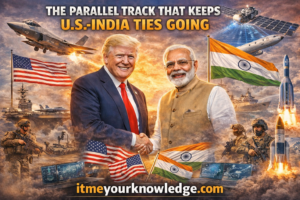
The concurrent path that maintains U.S. India relations
In 2025, despite political tensions and the delay of the eagerly awaited Quad Leaders’ Summit in India, the foundational processes of India-United States collaboration continue to be strong and steadily progressing. Although political involvement seems minimal, especially in light of U.S. trade sanctions against India and its improving relationship with Pakistan, the institutional partnership between the two democracies is still growing, especially in areas of defense and technological collaboration. The trips of India’s External Affairs Minister S. Jaishankar and the Chief of the Indian Navy to the U.S. should be understood within this context.
The Quad Leaders’ Summit, originally set to take place in New Delhi, has been postponed due to unclear communication from officials, highlighting ongoing bilateral tensions characterized by deteriorating trade relations. The U.S. tariff system imposed on Indian products and New Delhi’s adjustment of its diplomatic stance due to views of a “G-2” type reconciliation between the U.S. and China have certain underlying elements. India’s exports to the U.S., which fell significantly in 2025, clearly reflect these tensions
Economic tensions remain, particularly due to U.S. tariffs on India’s acquisition of Russian crude oil, while China and Pakistan benefit from reduced tariffs and improved ties with the U.S. In exchange, Islamabad’s proposal, underscored by U.S. port access and essential mineral exports to American companies, represents an economic choice influenced by geopolitical factors. Washington’s pragmatic approach to balancing interests is evident in indications from U.S. officials that ties with New Delhi are crucial despite transactional demands
Maintaining collaborative efforts among institutions
Unlike strained political signals, institutional involvement has increased. The Quad Foreign Ministers’ meeting in Washington in July 2025 revealed new initiatives covering maritime security, transnational threats, economic collaboration, critical technologies, and humanitarian efforts. In a similar vein, Quad’s Counterterrorism Working Group conducted its third meeting in December 2025, all showcasing the Quad’s ongoing operational significance beyond just lofty political views
Defense collaboration constitutes the foundation of this resilience. Following the 2008 civil nuclear agreement between India and the U.S., defence and technology pacts have consistently strengthened. The historic signing of a decadelong Defence Framework Agreement in 2025 signifies a new phase, improving joint coordination, information exchange, and technological collaboration aimed at strengthening stability in the Indo-Pacific region. Regular bilateral military exercises, including Yudh Abhyas (‘War Practice’), Tiger Claw, and Malabar, demonstrate interoperability and foster trust among the forces.
Greased by defense and technological pacts
Following the political turmoil caused by the India-U.S. nuclear agreement, the relationship between the two countries has mainly been influenced by defence and technology pacts. Throughout the years, the two nations have entered into several agreements, such as the 2023 India-US Defence Acceleration Ecosystem (INDUS-X) and essential defence accords like the Logistics Exchange Memorandum Of Agreement (LEMOA) in 2016, the Communications Compatibility and Security Agreement (COMCASA, 2018), and the Basic Exchange and Cooperation Agreement (BECA, 2020) along with the Initiative on Critical and Emerging Technologies (2023) to facilitate and enhance logistical support, collaboration, and information sharing between their armed forces. In 2024, India’s Ministry of Defence and the U.S. Department of Defence signed the Security of Supply Arrangement (SOSA). In spite of political difficulties, defense collaboration stays robust
In October 2025, a significant 10-year defence framework agreement was signed by U.S. Secretary of War Pete Hegseth and India’s Defence Minister Rajnath Singh. This long-awaited pact aims to enhance coordination, information sharing and technological collaboration to promote regional stability and deterrence.
Building on years of growing strategic convergence, the agreement reinforces defence as a core pillar of India-U.S. relations. Further bolstering defence ties, Indian aerospace giant, Hindustan Aeronautics Limited signed a billion-dollar deal, in November 2025, with the U.S.’s General Electric for fighter jet engines. Similarly the joint U.S.-India NASA ISRO Synthetic Aperture Radar (NISAR) satellite, launched in July 2025 for disaster resilience, agriculture and infrastructure planning requirements adds to the technological jointmanship. At the infrastructural and regional levels, the inaugural Quad Ports of the Future Conference, held around India Maritime Week in Mumbai in early November 2025, brought together delegates from 24 Indo-Pacific partners, focusing on developing resilient and secure ports that leverage shared expertise and investments. Co-organised by the Ministry of Ports, Shipping, and Waterways and the Ministry of External Affairs, it emphasised that quality infrastructure development is a crucial dimension of Quad cooperation, underlining the broader regional connectivity.
Build deeper institutional understanding
Despite political challenges, this enduring institutional engagement reveals the India-U.S. relationship’s dual-track dynamic. While political leaders manage strategic diplomacy with and
national interests, the bureaucratic and institutional frameworks continue to sustain and evolve core collaborations. Despite institutional challenges such as domestic regulatory frameworks and concerns about technology interoperability, mutual regional interests drive this continuity.
Such institutional continuity may well be the relationship’s greatest strength, fostering trust while shielding essential cooperation from political volatility. However, analysts have cautioned that bilateral ties may struggle to regain full momentum, even if trade disputes are resolved.
Looking ahead to 2026, both nations must invest in a deeper institutional understanding defence and beyond. Learning about structures and institutions, appreciating the processes, and developing resilient relationships with other countries require continuous e orts. Expanding cooperation into broader sectors can build the mutual trust essential during political lows. The resilience of the India-U.S. partnership will depend heavily on these parallel institutional tracks, which have so far, quietly but effectively, maintained the alliance’s robustness and strategic relevance in an ever-evolving geopolitical landscape. While political summits may pause, institutions keep the dialogue alive, working together on mutual areas, and having long-term partnerships that can survive the short and medium-term headwinds.
