Earthlife consists of cosmic materials, research on asteroid Bennu suggests
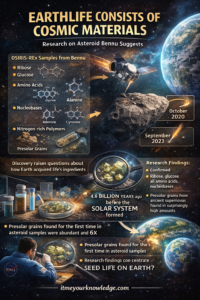
Samples from Bennu collected by OSIRIS-REx reveal that the asteroid contains ribose, glucose, amino acids, and nucleobases; this finding also involves nitrogen-rich polymers and presolar grains from supernovae, prompting inquiries about how Earth obtained the building blocks of life
On December 2, three teams published papers reporting Bennu contains sugar and other important molecules required to form RNA, and is also surprisingly abundant in supernova dust from a time before the sun formed.
As the solar system developed from the swirling cloud of dust and gas around the sun, numerous smaller rocks were pushed around and frequently clustered together. Bennu’s bigger parent asteroid was created similarly approximately 4.6 billion years ago, around the same period as the sun, in a region beyond Saturn. As Jupiter moved to its current orbit, the parent was thrust into the asteroid belt, resulting in collisions with other boulders. Throughout millennia, pieces from the progenitor formed Bennu, which currently orbits the sun between Earth and Mars.
In a Nature Geoscience paper, scientists led by Tohoku University in Japan reported finding ribose, the sugar molecule present in RNA, and glucose, the sugar molecule required
for metabolism, on Bennu. Together with previous findings of amino acids and all the five nucleobases found in DNA and RNA, the entire inventory of molecules scientists believe are
needed for life have now been confirmed on Bennu.
“To transform 5-C into 6-C sugar, the ideal combination of environmental conditions, including minimal amounts of liquid brine, appropriate pH levels, and extremely low temperatures, is necessary—conditions that the asteroid had at its formation,” said Kuljeet KaurMarhas, professor and leader of the Planetary Labs Analysis Section at the Physical Research Laboratory, Ahmedabad, who studies samples from the asteroid Itokawa
The results bolster the ‘RNA world’ theory: that primordial life relied on RNA for genetic information and catalytic roles, prior to the emergence of DNA and proteins. The research suggests that the prevalence of asteroids such as Bennu in the inner solar system supplied sugars and amino acids, facilitating the emergence of life on Earth over 3.5 billion years ago
Chemical processes
Researchers have additionally noted indications of chemical reactions among ices creating polymer molecules prior to the melting of the ices. In a Nature Astronomy article, another group from NASA described the finding of polymers composed of nitrogen- and oxygen-laden substances on Bennu. This substance, known as carbamate, was likely soft and rubbery upon its formation, solidifying over time. Researchers have not discovered this substance in samples from outer space previously
When Bennu’s parent was created, ices of volatile compounds such as frozen ammonia, recognized for collecting on the original surfaces of asteroids, might have experienced heating due to random radioactive decay. This would have melted the ice, allowing it to infiltrate rocky crevices and leave behind the dissolved salts and minerals. Bennu might have ‘received’ a portion of this.
Piece of this. Dust and gas in the early presolar system were formed from other exploding stars. By analyzing the dust, astronomers hope to find clues about the elements that made up its counterpart in the early solar system, which could help understand how planets formed.
In a third paper also published in Nature Astronomy, a different NASA team showed the presolar grains on Bennu had indeed been disturbed and moved around by moving liquids on the asteroid’s surface. The concentration of presolar grains was at least 6x higher than in other similar asteroid and meteorite samples.
The team also reported signs the grains had been singed by heat released when the great mass of dust collapsed to form our sun.
Research on the grains showed they came from different kinds of stars and supernovae. Among these, the levels of grains from supernovae were the greatest, suggesting it was found in large amounts in the region of space where Bennu’s progenitor formed
“The primary question is why there exists such a large quantity of presolar grains from supernova origins, given that Bennu resembles many other asteroids in its vicinity,” stated Dr. Marhas, who also evaluated the presolar grains report
“Will we find similar concentrations if we sample previously studied asteroids in different locations or is there something specific that makes the ordinary-seeming Bennu extremely special?”
What is India’s status regarding rabies occurrence and management?
