Which airports are undergoing privatization ?
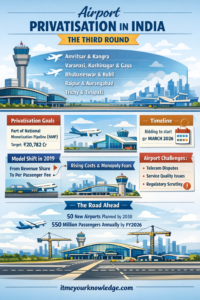
How were the places selected? When is the tender process likely to begin? What are the privatization goals a part of? When was the revenue-sharing model replaced by per passenger fee? How does it impact airfares? What are some of the issues being raised by airports?
The third round of airport privatization, covering 11 airports to be opened for bids in five bundled groups, has moved a step forward with the Ministry of Civil Aviation sending a proposal to the Public Private Partnership Appraisal Committee (PPPAC) for its in-principle clearance and detailed scrutiny. According to government officials, the five bundles, each comprising metro and non-metro airports, include airports at Amritsar and Kangra; Varanasi, Kushinagar and Gaya; Bhubaneswar and Hubli; Raipur and Aurangabad; Trichy and Tirupati.
What are the steps involved?
After the PPPAC finishes its assessment and the Union Cabinet approves the plan, private operators will be invited to bid, as the government intends to initiate the tendering process by March 2026
The 11 airports were chosen from all AAI (Airports Authority of India) facilities managing 0.1-1 million passengers per year. Future traffic growth projections and required investments subsequently refined the selection to these leading candidates for the third privatization round
The advancement occurs six years after AAI initially revealed the strategy for privatizing 25 airports, following the privatization of six airports secured by the Adani Group. Reports indicate that the other 14 airports will be considered for privatization in later phases
The objectives of privatization are included in the National Monetization Pipeline (NMP), which seeks to monetize existing public infrastructure to free up unused capital for reinvestment in other assets. Inaugurated in August 2021, the NMP established a total indicative objective of 6 lakh crore to be obtained by leasing brownfield infrastructure assets throughout the four-year span from FY 2022 to FY 2025.
The goal for the airport industry via the privatization of 25 airports was set at 20,782 crore, representing almost 4% of the total NMP value. Overall, 88.3% of the complete NMP objective has been reached by different infrastructure ministries, with roads and railways being the primary contributors, while the aviation sector continues to lag behind. The Union Budget 2025- 6 declared the initiation of the Asset Monetization Plan 2025-30 to reinvest 10 lakh crore
“The goal must be to guarantee that air travel expenses for smaller cities stay manageable.”
When did the privatization of airports start?
Privatization of airports started in 2003 under the NDA government. It approved the privatization of two browneld airports, i.e., Delhi and Mumbai airports, with 26% AAI stake
and 74% stake owned by private JV partners. Delhi went to a GMR-led consortium in 2006,
Mumbai to a GVK-led consortium in the same year via competitive bidding based on a revenue-share model. Two greenfield PPP airports followed, which included Bengaluru and Hyderabad in 2004.
In 2019, six more airports (Ahmedabad, Lucknow, Jaipur, Mangaluru, Guwahati, Thiruvananthapuram) were privatized, which were all won by the Adani Group. The revenue-share model was replaced by per passenger fee.
For the third round of privatization, the PPPAC will evaluate key aspects, including revenue-sharing models versus per-passenger fees, cross- subsidization between metro and non-metro airports in a bundle, and the need for a cap on the number of airports a single entity bags. It will also assess optimal land parcels for non-aeronautical revenue streams that are used
to o set airline and passenger fees, and whether the User Development Fee collected from
passengers as a component in the airfare will be determined for each airport independently or as a joint asset.
What are the concerns?
Recently, when IndiGo was forced to cancel nearly 5,000 fights in the first two weeks of December, widespread concern was raised about the risks of a duopoly in India’s aviation sector. Similar dangers are now emerging in the airport sector, where a monopoly has steadily
taken shape over the past five years, with the Adani Group bagging 8 airports — six through
privatization, followed by Mumbai and Navi Mumbai airports, where it acquired GVK’s stake.
Consider the recent dispute involving telecom operators, who approached the Department of
Telecommunications over what they describe as “extortionary” charges levied at the newly inaugurated Navi Mumbai Airport to allow the use of its in-building solutions and refusal of right of way to set up infrastructure to provide cellular services.
What is causing the increase in expenses for airlines and travelers?
Privatization frequently sparks worries regarding escalating expenses for airlines and travelers, even with heightened investments in infrastructure. These worries are amplified when a significant monopoly arises, resulting in airline operators having little negotiating power and passengers having almost none
Consider Thiruvananthapuram Airport, where, after its initial tariff revision post-privatisation to Adani, sanctioned by the Airport Economic Regulatory Authority (AERA), the user development fee included in the airfare for domestic passengers rose from 506 to 770 for one year, with additional increases in the following years. Aircraft landing fees were also significantly raised
The typical person’s complaints involve expensive taxi fares at airports, overcrowding in terminal buildings, restricted availability of wheelchairs, and being forced to pay for porter services to address accessibility issues. An initial step has been taken as the airport tariff regulatory authority is now assessing airports based on service delivery standards and suggesting a penalty for non-compliance. The service benchmarks comprise wait times at security checkpoints, check-in durations, presence of assistance desks, and travel time between terminals, among others. It intends to conduct an external assessment of these factors and impose a 5% decrease in airport tariffs, leading to a lowered development fee for users
What lies ahead?
Currently, only around 6% of Indians travel via air, underscoring the vast potential for growth in the world’s third-largest aviation market. Though affordability is a significant aspect, the low adoption rate indicates that air travel in India is far from being fully developed. To address increasing demand, the government aims to construct 50 new airports within the next five years and to enhance the current network of 163 airports. By FY2026, the airports in India are
Anticipated to possess a total passenger-handling capability of approximately 550 million passengers each year (mppa), considering new infrastructures like Navi Mumbai Airport and the forthcoming Noida International Airport. Industry projections indicate that airport capacity must expand to approximately 850 mppa in the next five years. Fostering this growth will necessitate more than simply new airports and will also rely on the existence of financially strong airlines
What is India’s status regarding rabies occurrence and management?
